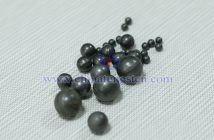
In heavy industrial equipment like rolling mills, bearings must withstand enormous impact loads, high temperatures, and harsh dust environments. Using cemented carbide balls (commonly known as tungsten carbide balls) as the rolling elements of bearings significantly improves their overall performance and lifespan.

1. Why Do Rolling Mill Bearings Need Cemented Carbide Balls?
Compared to ordinary bearing steel balls, cemented carbide balls exhibit significant advantages in the following aspects, making them particularly suitable for the working requirements of rolling mills:
Extremely high hardness and wear resistance: The hardness of cemented carbide balls is close to that of diamond. Under the high load and high-speed operating conditions of rolling mills, it can effectively resist the severe wear caused by metal-to-metal contact. Its wear resistance is dozens of times that of traditional steel balls, thus greatly extending the maintenance cycle and service life of the bearing.
Excellent load-bearing capacity: Cemented carbide balls have extremely high compressive strength. During the rolling process, bearings need to withstand enormous radial and axial loads. Cemented carbide balls can effectively disperse stress and prevent deformation or pressure damage caused by overload.
Excellent thermal stability: Cemented carbide balls maintain high hardness and other mechanical properties even at high temperatures, such as 1000 degrees Celsius. This characteristic ensures that the bearings maintain precise dimensions and stable performance even when the rolling mill generates high temperatures during prolonged operation.
Resistance to harsh working conditions: The rolling mill environment may contain corrosive media such as moisture and coolant. Cemented carbide balls have excellent corrosion resistance to acids and alkalis, preventing surface damage and failure caused by corrosion.

2. Application and Selection Considerations of Cemented Carbide Balls for Rolling Mill Bearings
In rolling mill bearings, cemented carbide balls are mainly used in high-load rolling bearings, such as the roller portion of four-row cylindrical roller bearings and four-row tapered roller bearings. These are the core support components of the rolling mill roll system.
Selecting the appropriate cemented carbide balls is crucial. Typically, YG8 (composition approximately 92% WC and 8% Co) and similar grades are common choices. These alloy grades, while ensuring high hardness, also possess better toughness due to the presence of a certain proportion of cobalt binder, making them capable of withstanding the unavoidable impacts and vibrations during rolling mill operation.