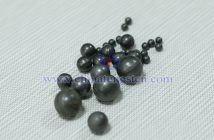
Miniature bearings are widely used in precision instruments, medical equipment, aerospace, and microelectronics. One of their core components is the cemented carbide ball. These balls typically have a small diameter and possess extremely high hardness, wear resistance, and dimensional accuracy, making them a key material for ensuring high speeds, low noise, and long lifespans in miniature bearings.

1. Material Properties of Cemented Carbide Balls for Miniature Bearings
Cemented carbide balls are primarily made of tungsten-cobalt alloy with a moderate cobalt content and extremely high hardness. Compared to traditional steel balls, they have a higher density, providing better centrifugal force and stability. They have a low coefficient of thermal expansion and minimal deformation at high temperatures. They are highly corrosion-resistant, resisting acid and alkali corrosion, making them suitable for harsh environments such as those used in medical endoscopes. These properties enable the balls to maintain stable performance under complex operating conditions, ensuring the overall reliability of the bearing.
2. Manufacturing Process of Cemented Carbide Balls for Miniature Bearings
The production process employs powder metallurgy: Tungsten and cobalt powders are first mixed and ball-milled to form a uniform slurry; spray-dried to form particles; cold isostatically pressed into micro-ball blanks; high-temperature sintering for densification; and precision grinding and polishing to a smooth surface. Strict dimensional tolerance control ensures minimal sphericity error. Advanced processes such as hot isostatic pressing eliminate internal porosity and improve strength. These rigorous steps ensure that each ball meets precision standards, with a defect-free surface and dense, uniform internal structure.

3. Performance Advantages of Cemented Carbide Balls for Miniature Bearings
In miniature bearings, cemented carbide balls have a low coefficient of friction, allowing for very high rotational speeds, far exceeding the limits of steel balls. They exhibit excellent wear resistance, significantly extending service life. Low magnetism avoids electromagnetic interference, making them suitable for precision medical equipment. Low vibration and noise meet quiet operation requirements. These advantages allow the bearing to remain stable during high-speed rotation, reducing energy loss and improving system efficiency.
4. Applications of Cemented Carbide Balls in Miniature Bearings
Cemented carbide balls in miniature bearings are used in hard disk drive spindle supports to ensure stable data reading; dental handpiece bearings to withstand high-pressure steam sterilization; and drone gyroscopes to achieve a balance between miniaturization and high precision. These applications fully utilize their wear-resistant, high-speed, and low-noise characteristics to drive device miniaturization and performance improvements.