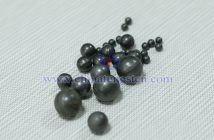
Cemented carbide bearing balls are spheres made of cemented carbide, an ultra-hard material, used in critical moving parts of bearings. They are core components of high-end bearings, representing a top-tier solution for extremely demanding operating conditions.

1. Materials and Properties of Cemented Carbide Bearing Balls
Cemented carbide, commonly known as "tungsten steel," is a powder metallurgy material. It is primarily composed of a high-hardness refractory metal carbide (such as tungsten carbide WC) as the hard phase and a tough metallic binder phase (usually cobalt Co), sintered at high temperatures. This structure gives cemented carbide:
Extremely high hardness (HRA can reach over 90, far exceeding that of quenched steel), making it extremely wear-resistant.
Excellent compressive strength, capable of withstanding enormous loads without deformation.
Good rigidity and moderate toughness.

2. Why are Cemented Carbide Bearing Balls Needed?
Traditional bearing steels (such as GCr15) perform excellently in most conventional applications, but they fail rapidly under certain extreme conditions. Carbide ball bearings are designed to address these challenges:
Extreme Wear Conditions: In environments containing high levels of dust and abrasive particles, ordinary steel balls wear down quickly, leading to increased bearing clearance and loss of precision. Carbide's unparalleled wear resistance extends their lifespan by several times, even tens of times.
Highly Corrosive Environments: While standard carbide corrosion resistance is not perfect, by using grades with corrosion-resistant binder phases (such as nickel), it can withstand many acidic and alkaline media, while ordinary steel balls corrode rapidly.
High Temperatures and Lubrication-Free Operation: In situations where lubricants cannot be used or where operating temperatures are high, carbide maintains its shape and performance, while steel softens or sticks together.
High precision and high stability requirements: Due to its extremely low coefficient of thermal expansion and extremely high elastic modulus, cemented carbide balls are extremely stable in size when the temperature changes, and can maintain the preload and rotational accuracy of the bearing for a long time. They are widely used in high-precision machine tool spindles, aerospace and other fields.