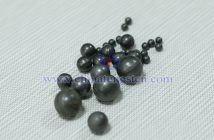
Cemented carbide bearing balls are high-performance rolling elements, primarily made of tungsten-cobalt-based cemented carbide, playing a crucial role in mechanical equipment. They are mainly used in various bearing structures, acting as balls to support and guide rotating components, achieving low-friction, high-efficiency motion transmission.

First, the core function of cemented carbide bearing balls is to reduce friction and wear. Traditional steel balls are prone to deformation or wear under high-speed or heavy-load conditions, while cemented carbide possesses extremely high hardness and wear resistance, forming stable rolling contact at the friction interface and significantly reducing energy loss. This makes the bearing operate more smoothly, extending equipment life, and is particularly suitable for precision instruments and high-speed machine tools.
Second, it improves load-bearing capacity and stability. The density and strength of cemented carbide bearing balls are superior to ordinary materials, allowing for uniform load distribution and avoiding localized stress concentration. In heavy machinery such as automotive drivetrains or wind turbines, these ball bearings can withstand greater impacts and vibrations, ensuring precise alignment of rotating shafts, reducing noise and vibration, and improving overall system reliability.
Furthermore, cemented carbide bearing balls bearings possess excellent corrosion resistance and high-temperature resistance. In harsh environments, such as chemical equipment or high-temperature furnaces, they resist chemical erosion and thermal deformation, maintaining dimensional stability. This not only expands the application range of bearings but also reduces maintenance frequency, making them suitable for fields such as aerospace and medical devices.

Cemented carbide bearing balls also promote energy efficiency and environmental protection. In electric motors or pumps, the low-friction design reduces heat generation, lowers energy consumption, and supports green manufacturing. Simultaneously, their long lifespan reduces replacement needs, saving resources.
In conclusion, cemented carbide bearing balls, through enhanced durability, optimized motion performance, and adaptability to extreme conditions, have become indispensable components of modern industry. It drives the development of equipment towards higher precision and higher reliability, and is widely used in fields such as automobiles, aviation, energy and precision manufacturing to ensure the efficient and safe operation of mechanical systems.