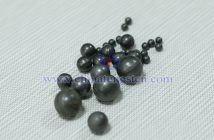
Cemented carbide bearing balls, typically made from tungsten carbide and metallic cobalt using powder metallurgy, represent the pinnacle of bearing ball material performance. They possess excellent characteristics such as ultra-high hardness, extreme wear resistance, strong compressive strength, dimensional stability, and good corrosion resistance, offering unparalleled advantages in fields with extreme requirements for reliability, lifespan, and precision—such as aerospace, high-end manufacturing, energy exploration, and precision measuring instruments.

First and foremost, the most prominent characteristic of cemented carbide bearing balls is their extremely high hardness and superior wear resistance. The hardness of cemented carbide is far greater than that of traditional bearing steel, meaning it effectively resists wear caused by contact stress, fretting, and abrasive particles. In environments with dust or contaminants, or in situations prone to fretting wear at high speeds, cemented carbide balls maintain their original dimensional accuracy and surface finish, thus significantly extending the bearing's service life.
Secondly, cemented carbide bearing balls possess extremely high compressive strength. Although materials with extremely high hardness are often brittle, through the proper formulation of metallic binder phases such as cobalt, cemented carbide balls exhibit sufficient toughness to resist fracture and deformation under enormous static and impact loads. This characteristic makes them ideal for heavy-duty, high-pressure applications, such as in the spindles of oil drilling, heavy machinery, and precision machine tools, where they can stably withstand enormous radial or axial pressures.

Furthermore, cemented carbide bearing balls possess excellent dimensional stability and corrosion resistance. Their low coefficient of thermal expansion results in minimal dimensional fluctuations with temperature changes, which is crucial for maintaining the operational accuracy of high-precision bearings in variable-temperature environments. Simultaneously, they exhibit excellent resistance to various chemical media, such as acids, alkalis, and solvents, far surpassing that of ordinary steel balls, making them suitable for corrosive environments such as chemical and marine environments.
In addition, cemented carbide bearing balls have extremely high rigidity modulus and produce negligible elastic deformation under load. This helps to improve the rigidity and dynamic response accuracy of the entire bearing system, which is a crucial performance characteristic for high-end CNC equipment and precision instruments.