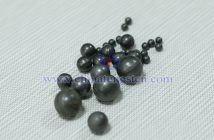
Cemented carbide bearing balls typically refer to balls made of tungsten-cobalt cemented carbide. Their chemical properties are primarily determined by their two-phase microstructure: (1) Hard phase: Tungsten carbide, chemical formula WC. (2) Bonding phase: Cobalt, chemical formula Co. The chemical properties of cemented carbide bearing balls are a comprehensive reflection of the properties of these two main components and are influenced by their bonding state.

I. Summary of Core Chemical Characteristics of Cemented Carbide Bearing Balls
1. High inertness/excellent chemical stability: Exhibits extremely high resistance to most chemical substances at room temperature.
2. Excellent corrosion resistance: Exhibits excellent corrosion resistance to non-oxidizing acids (such as hydrochloric acid, dilute sulfuric acid), organic acids, alkaline solutions, and most organic solvents.
3. Sensitive to oxidizing media: Corroded in oxidizing acids (such as nitric acid, aqua regia) and strong oxidizing environments. 4. Easily oxidized at high temperatures: Oxidation occurs when air is heated to high temperatures (approximately 500-600°C or higher).

II. Detailed Chemical Property Analysis of Cemented Carbide Bearing Balls
1. Corrosion Resistance to Acids and Alkalis
(1) Excellent Corrosion Resistance:
Non-oxidizing acids: such as hydrochloric acid, dilute sulfuric acid, phosphoric acid, etc. This is because in these acids, neither the hard phase WC nor the binder phase Co undergoes strong oxidative dissolution. A very thin, dense passivation film forms on their surfaces, preventing further reaction. Therefore, it performs exceptionally well in marine environments (containing chloride ions) or certain chemical environments.
Organic acids: such as acetic acid, citric acid, etc., have virtually no effect.
Alkaline solutions: such as sodium hydroxide, potassium hydroxide, ammonia, etc. Cemented carbide exhibits extremely strong resistance to these solutions and is almost unaffected by corrosion. This is because WC and Co are very stable in alkaline environments.
(2) Situations with poor corrosion resistance:
Oxidizing acids: such as nitric acid, aqua regia, and concentrated sulfuric acid. These acids have strong oxidizing properties and can simultaneously oxidize and dissolve the binder phase cobalt and tungsten carbide. Cobalt (Co) will be oxidized into cobalt ions (Co2?) and enter the solution. Tungsten carbide (WC) will be oxidized into tungstic acid (H?WO?) and carbon dioxide (CO?). This is a major weakness in the chemical properties of cemented carbide.
Hydrofluorine acid: can also corrode cemented carbide.
2. Oxidation resistance
Cemented carbide is extremely stable in air at room temperature and will not rust or discolor, which is a significant advantage over bearing steel.
However, in high-temperature air (usually starting at 500°C to 600°C, the specific temperature depending on the cobalt content and alloy particle size), its oxidation resistance deteriorates. The binder phase cobalt will first be oxidized into cobalt oxide (CoO). Tungsten carbide oxidizes into yellow tungsten trioxide (WO?). This oxide is porous and cannot protect the internal materials, leading to continuous oxidation. Therefore, cemented carbide bearings are not suitable for long-term operation in high-temperature, oxygen-rich environments.
3. Chemical Reactions with Other Metals
Cemented carbide balls are very stable and generally do not undergo significant solid-state chemical reactions (diffusion or formation of intermetallic compounds) with common bearing housing or cage materials (such as stainless steel, ceramics, etc.).
However, under certain extreme conditions (such as high temperature and high pressure), cobalt may exhibit weak interactions with some metals, but this is usually negligible in conventional bearing applications.