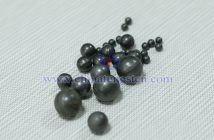
Low-noise tungsten carbide bearing balls are precision components designed specifically for applications requiring extreme quietness and long lifespan. They are primarily sintered from high-purity tungsten carbide (WC) or silicon carbide (SiC) and other carbide materials, exhibiting extremely high hardness and excellent wear resistance, maintaining a very low wear rate even at high speeds.

Compared to traditional steel balls, the most significant advantage of tungsten carbide bearing balls lies in their substantial suppression of vibration and noise. Steel balls have microscopic irregularities on their surface, which cause repeated impacts with the raceway during high-speed rotation, producing a noticeable whistling sound. In contrast, tungsten carbide balls, after ultra-precision grinding, achieve a mirror-like surface roughness and extremely low roundness error, resulting in virtually no microscopic impact. Therefore, at the same rotational speed, noise is reduced by 15-30 decibels, making the operation almost imperceptible to the human ear. This makes them particularly suitable for high-end audio turntables, precision medical instruments, silent fans, camera tripods, and high-end fishing tackle—applications where sound is extremely sensitive.

Furthermore, carbide has a higher density, resulting in heavier balls and smoother rotation, effectively suppressing minute vibrations caused by load changes and further reducing abnormal vibrations. Its corrosion resistance far surpasses that of stainless steel, maintaining dimensional stability even in humid, acidic, and alkaline environments, and its lifespan is often several times, even ten times, longer than that of ordinary steel balls.
In high-end consumer applications, many audiophiles replace the original steel balls with tungsten carbide ball bearings. This single step can transform the sound of a turntable, fan, or hard drive from "clearly audible" to "inaudible," resulting in a noticeably quieter operation. True quietness is not about masking sound, but about eliminating unnecessary vibrations at their source, and low-noise tungsten carbide ball bearings are one of the keys to achieving this "invisible silence."