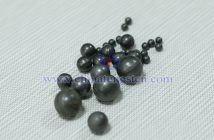
Cemented carbide (primarily tungsten carbide-based cemented carbide, WC-Co or WC-Ni) bearing balls have become the preferred material in harsh environments where traditional steel balls fail rapidly due to their extremely high corrosion resistance. Ordinary bearing steels (such as GCr15) quickly develop pitting corrosion, stress corrosion cracking, or even complete dissolution when exposed to acids, alkalis, seawater, salt spray, or chloride-containing media, while cemented carbide balls remain virtually unaffected, maintaining surface smoothness and dimensional stability over a wide pH range of 1-14.

The most typical applications of cemented carbide bearing balls are in chemical pumps, marine equipment, and food and pharmaceutical machinery. In brine pumps in the chlor-alkali industry and acidic slurry pumps in titanium dioxide production, cemented carbide balls can extend bearing life from a few months to several years, greatly reducing downtime for maintenance. In offshore oil platforms, seawater cooling pumps and wave power generation systems extensively utilize cemented carbide ball bearings to combat seawater corrosion. The food and pharmaceutical industries, with their extremely high cleanliness requirements, find cemented carbide rust-free, non-magnetic, and free of metal ion release, fully meeting FDA and GMP requirements. It is commonly used in critical components such as high-speed separators and homogenizers.

Compared to ceramic ball bearings, cemented carbide, while slightly less hard, offers better toughness and impact resistance, exhibiting a more balanced performance under both corrosive and high-load conditions. Compared to stainless steel or Hastelloy ball bearings, cemented carbide demonstrates superior wear resistance and corrosion resistance, especially in corrosive slurries containing solid particles, where it is virtually the only metallic material capable of long-term survival.
In practical applications, cemented carbide ball bearings are typically paired with corrosion-resistant alloy cages and rings (such as Hastelloy, titanium alloys, and duplex stainless steel) to form fully corrosion-resistant bearings; alternatively, hybrid ceramic bearings (cemented carbide ball bearings + silicon nitride rings) are used to further enhance performance. In strong oxidizing media (such as concentrated nitric acid), cobalt-free or low-cobalt grades such as WC-Ni and WC-NiCrMo should be selected to avoid the dissolution of cobalt.